How the Environment Became a Culture War,
And Why It Doesn’t Have to Be

A message from our Executive Director, Dr. James Strittholt
When I was in high school, environmental protection was a non-partisan issue in America. Richard Nixon — second only to Theodore Roosevelt in environmental impact — created the EPA, supported the first Earth Day, and signed the Clean Water Act, Clean Air Act, and Endangered Species Act. Announcing the ESA, he declared, “Nothing is more precious and worthy of preservation than the rich array of animal life with which our country has been blessed.” Conservation enjoyed broad bipartisan support, a tradition George H.W. Bush continued as well.
The modern Republican Party has become the antithesis of these policies. So, what happened?
Reagan’s presidency marked the turning point. His campaign against federal regulation pulled environmental protection into the broader debate about government’s role in the economy. Business interests began framing environmental rules as job-killers and government overreach — an argument with real traction in rural mining, manufacturing, and logging communities that trend conservative. That framing persists to this day.
By the 1990s and 2000s, environmentalism became associated with urban liberals, even as many conservatives maintained a deep personal relationship with the land. Fossil fuel industries, facing existential regulatory threats, invested heavily in think tanks, lobbying, and deliberate doubt-manufacturing about climate science — tactics strikingly similar to those used by the tobacco industry decades earlier. The goal was never to win a scientific argument, but to create enough confusion to prevent action.
And yet the underlying values never actually divided along party lines. Polls consistently show that majorities across party lines support clean air, clean water, national parks, and specific environmental protections when asked about them on their own merits. The polarization is largely a political and media phenomenon projected onto ordinary voters. The word “environmentalism” became a partisan label detached from the genuine desires beneath it, and that gap is where enormous common ground was lost.
We don’t have to accept that loss as permanent. Love of land, clean water, and wild places has never truly belonged to one party. It belongs to anyone who has fed backyard birds, cast a fishing line, or simply wanted their children to inherit a world as beautiful as the one they were given. That American commitment never really disappeared. It’s just waiting to be called by its right name.
Global Wildfire Collective News
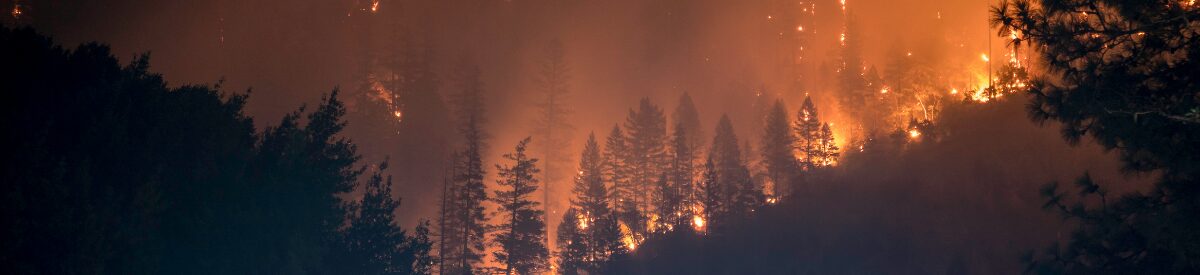
Conservation Biology Institute’s Global Wildfire Collective (GWC) initiative recently received funding to pursue its proposed FIRE-NET project. The project aims to operationalize and expand the GWC as a hub for accelerating wildfire resilience and recovery by enabling responsible knowledge transfer across fire-prone regions globally. Core research objectives include co-producing region- and ecoregion-specific resilience roadmaps that integrate scientific, indigenous, practitioner, and community expertise; developing a scalable Wildland Urban Interface (WUI) typology and probabilistic fire occurrence models to identify generalizable patterns versus context-dependent dynamics; and building a standardized foundation of measurements, models, and strategies applicable across diverse biomes. The project will also work to expand open-access digital infrastructure (including the GWC Spatial Data Gateway, multilingual Discussion Forum, and AI-supported Knowledge Base), and deliver capacity-building programs such as webinars, regional workshops, and policy engagement at the UN level.
Beyond research outputs, the project seeks to foster a durable international collaborative platform that bridges science, policy, and practice — particularly by connecting underrepresented regions such as Colombia and Chile with well-studied fire systems in the Western U.S. — ultimately advancing equitable, culturally grounded solutions to shared global wildfire challenges. Together, these activities span ecological, social, technological, and governance dimensions of wildfire resilience, positioning the Global Wildfire Collective as a central platform for integrated wildfire science worldwide.
Administered by the Buckminster Fuller Institute, this research is funded through the U.S. National Science Foundation (NSF) Fire Science Innovations through Research and Education (FIRE) program, a collaboration among NSF, NASA, Department of Defense SERDP/ESTCP, and the Gordon and Betty Moore Foundation to advance wildland fire research.
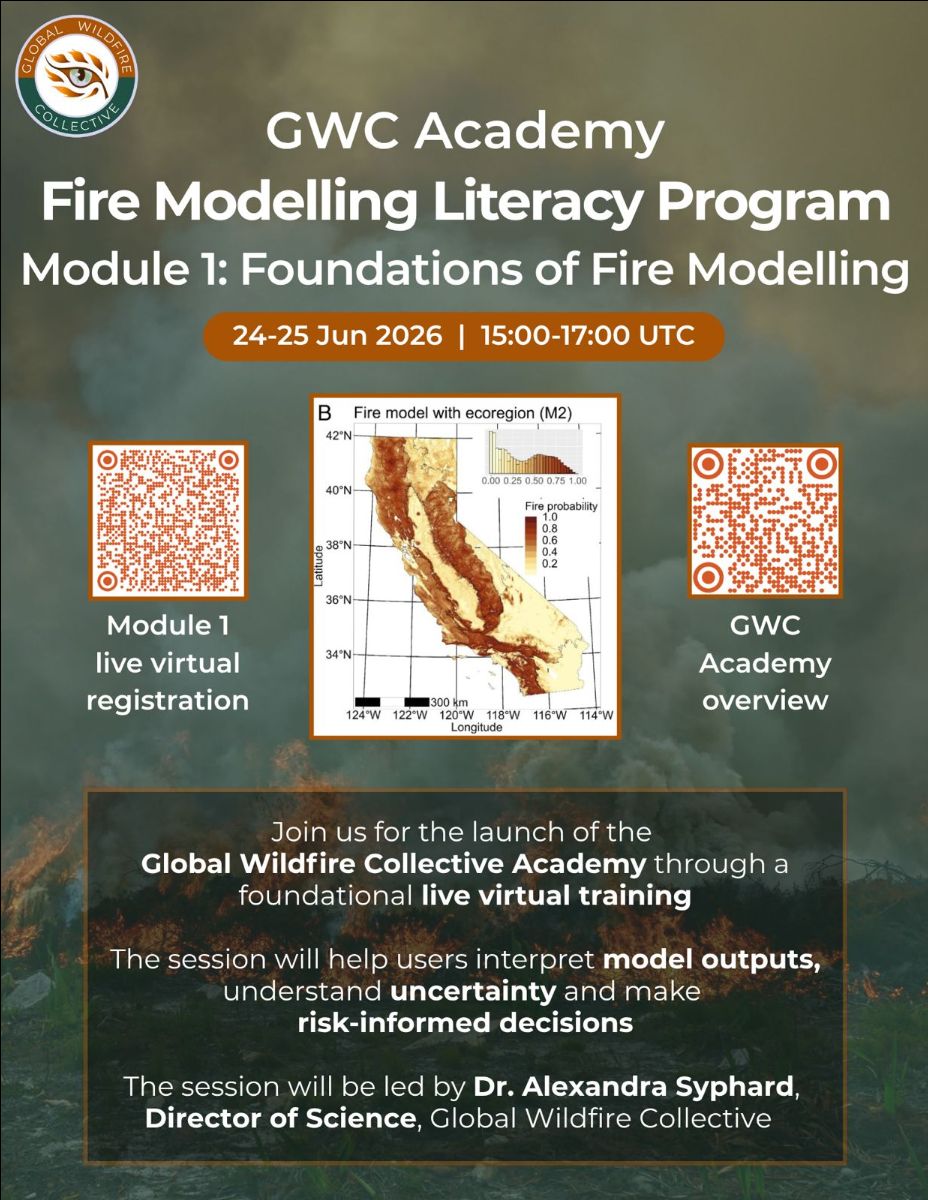
On June 24–25, 2026, GWC will host its inaugural Fire Modeling Literacy for Risk-Informed Decision-Making workshop — and registration is now open.
Leading researchers from the GWC community led by Dr. Alexandra Syphard (Senior Research Scientist at CBI) will go beyond the surface of fire modeling frameworks, revealing not just what each approach can accomplish, but where its limits lie and why those boundaries matter. Through comparative case studies, participants will come to understand a fundamental truth of fire science: there is no single “best” model — only tools matched, or mismatched, to the problem at hand.
Over two days and four hours of sessions, participants will:
- Establish a shared fire modeling vocabulary
- Gain exposure to machine learning, fire behavior, and simulation modeling frameworks
- Build foundational literacy in the modeling process
- Improve familiarity with common data sources and limitations
- Strengthen interpretation and decision framing under uncertainty
We’re offering discount codes to make FMLP training accessible across country income levels (according to the latest World Bank country income classification):
- Upper-middle income: 50% (code 50FMLP)
- Lower-middle income: 75% (code 75FMLP)
- Low-income: 90% (code 90FMLP)
- Limited fee waivers available; contact us if needed
Expanding Our Ocean of Knowledge: Two New Gateways on the Horizon
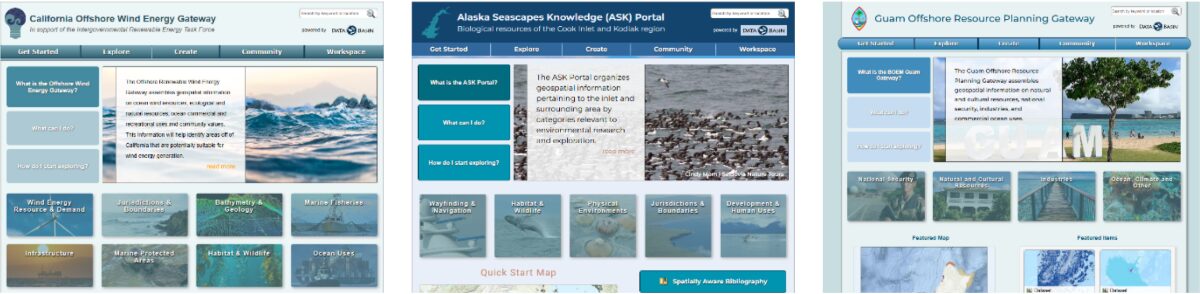
Our marine resource planning network is growing. Two new Data Basin Gateways — covering the Territory of American Samoa and the Commonwealth of the Northern Mariana Islands — are currently in development and expected to launch before year’s end.
The effort is part of an ongoing partnership with the Bureau of Ocean Energy Management (BOEM), which has been instrumental in bringing marine-focused gateways to life across the Pacific. Alongside the new additions, BOEM-supported gateways already serve California offshore wind planning, Alaska seascapes, and Guam’s offshore resources. Stay tuned for official launch announcements.