A Tribute to Wendell Berry
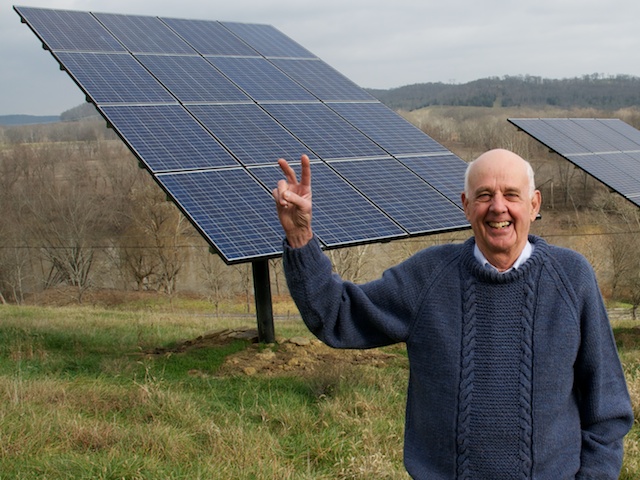
Photo by Guy Mendes, CC BY-SA 3.0 https://creativecommons.org/licenses/by-sa/3.0, via Wikimedia Commons
On August 31, we lost another giant. Wendell Berry was a novelist, poet, farmer, and environmental activist who devoted his life to reminding us of what truly matters. He had a rare gift for putting into words the deeper truths of our relationship with one another and with the natural world.
At a time when so much feels chaotic, and when life is too often reduced to a line on a balance sheet to be measured, consumed, and exploited with an added dose of cruelty or indifference in the pursuit of wealth. Berry offered a different way of seeing. He reminded us that the natural world has value beyond what we can extract from it. That a healthy landscape, a thriving community, and the creatures great and small with whom we share this planet are not commodities, but essential parts of a meaningful life.
If you are like me, there are times when the news and the state of the world can leave you feeling anxious or discouraged. At those moments, I often look for ways to ground myself – hang out with our animals, play in the garden, take a walk in the woods, or read something inspiring. Wendell Berry’s writing has a way of slowing us down, grounding us in the world around us, and reminding us that there are things of enduring value that cannot and should not be measured on a balance sheet.
Perhaps, in these unsettled times, a little Wendell Berry is just what we need. He will be missed but his writings will endure – what a legacy to leave for future generations.

The Peace of Wild Things
by Wendell Berry
When despair for the world grows in me
and I wake at night at the least sound
in fear of what my life and my children’s lives may be,
I go and lie down where the wood drake
rests in his beauty on the water, and the great heron feeds.
I come into the peace of wild things
who do not tax their lives with forethought
of grief. I come into the presence of still water.
And I feel above me the day-blind stars
waiting with their light. For a time
I rest in the grace of the world, and I am free.
Climate Cooling Initiative Launches to Advance Nature-Based Climate Cooling
CBI is proud to be a core member of the Climate Cooling Initiative and to contribute our expertise in conservation science, spatial analysis, and collaborative tools to this important global effort.
Last week, the Climate Cooling Initiative (CCI) announced the launch of a new international effort to protect, restore, and strengthen Earth’s natural climate-cooling systems at a scale commensurate with the global climate challenge.
CCI’s work is grounded in an important new synthesis paper, Cooling Climate Quickly: A New Perspective Yields New Options. The paper presents evidence that the degradation and loss of healthy, functioning ecosystems have contributed significantly to global warming—and, importantly, that restoring these ecosystems could help recover some of their lost climate-cooling capacity.
The opportunity is enormous. By bringing together science, ecological restoration, finance, policy, and implementation, CCI aims to accelerate the protection and restoration of natural ecosystems around the world. Restoring forests, wetlands, grasslands, soils, and other ecosystems can help moderate some of the impacts of climate change while the global transition away from fossil fuels continues to unfold over the coming decades.
The benefits extend far beyond climate. Restoring functioning ecosystems can also help address the global biodiversity crisis, improve soil and water health, strengthen ecosystem resilience, and sustain the many services that nature provides to people.
Nature has already been doing this work for us for millennia. The challenge and opportunity is to restore and strengthen that capacity at a scale that can make a meaningful difference.
Feed the Bugs to Feed the Bats: Building a National Framework for Bat-Friendly Gardening
You’ve heard of gardening for pollinators, but what should people plant if they want to help bats? CBI recently wrapped up a project with Bat Conservation International to provide a stronger scientific foundation for this perhaps unexpected conservation question. Because most of the 47 bat species in the US are insectivorous, the connection between a garden and a bat is often indirect. Native plants support insects, and those insects, in turn, provide the prey that bats depend on. This project, led by CBI ecologist Chris Cosma, brought those pieces together into a national framework linking plants, arthropods, and bats through their ecological interactions.
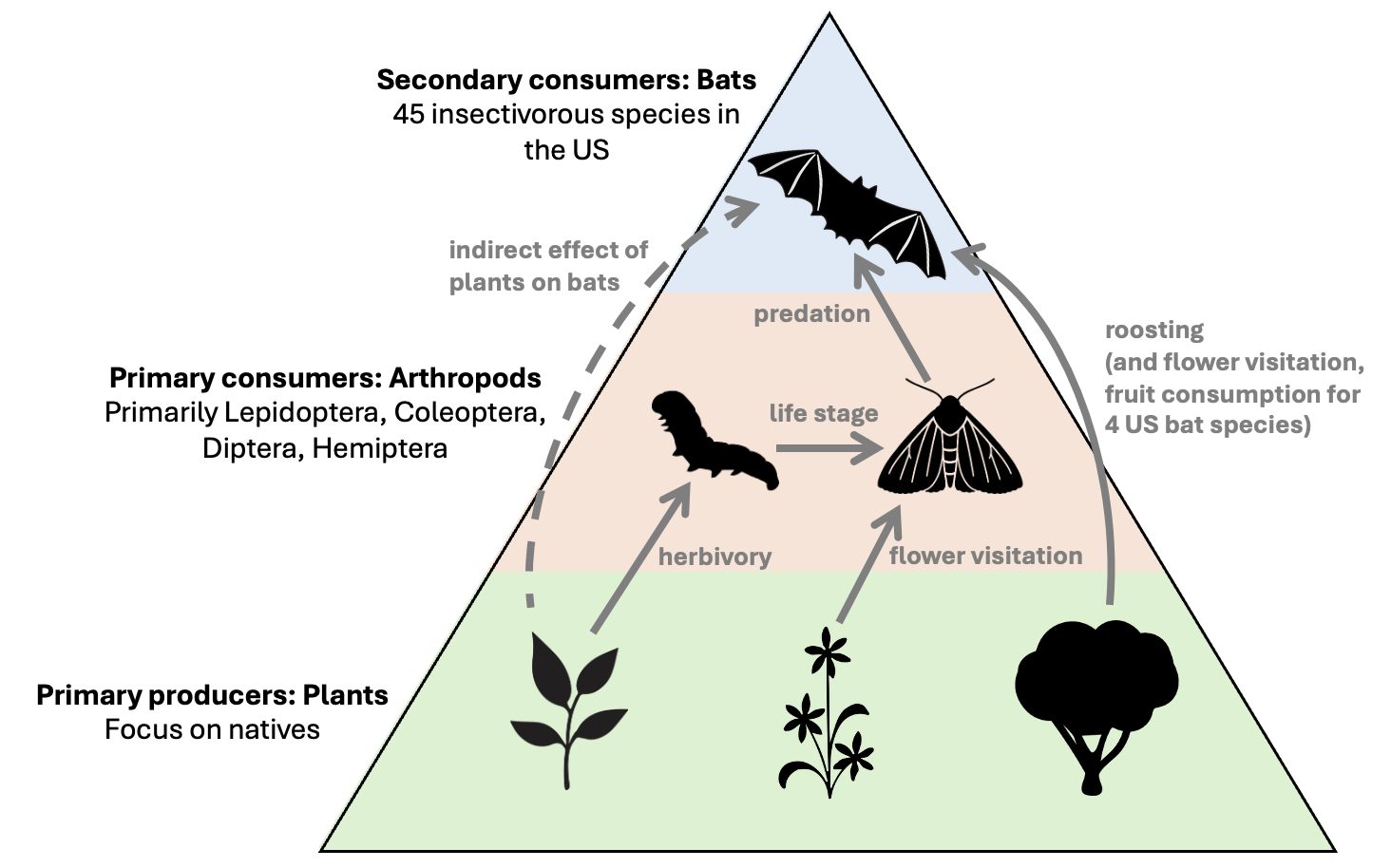
The result is an integrated database containing more than one million spatially-explicit plant-arthropod-bat interactions across the conterminous United States. The database combines bat diet records, plant-insect interactions, species distributions, ecological traits, and other information to build regional food webs and rank native plants according to their potential to support the bats occurring in a particular area. The project also provided Bat Conservation International with prototype interactive tools and downloadable ecoregional planting guides that demonstrate how this information can be translated into practical recommendations for gardeners and land managers.
The results provide encouraging support for the basic idea behind bat gardening. Nearly two-thirds of species-level bat prey associations involved insects or other arthropods with documented plant relationships, suggesting that plant choice can influence a substantial portion of the food base available to bats. Moths were especially important links between the two trophic levels. At the national scale, maples (Acer), cottonwoods and aspens (Populus), cherries and plums (Prunus), willows (Salix), and oaks (Quercus) emerged among the most consistently highly ranked plant genera, although the best choices vary substantially among ecoregions.
Overall, the project provides a strong foundation for a data-driven approach to bat gardening in the US, with important next steps focused on continued data additions, field validations, and the development of public-facing tools tailored to homeowners, restoration practitioners, and other end users.
Ultimately, the goal is to turn an increasingly rich body of ecological data into something people can act on—helping them choose the right plants in the right places to support insects, bats, and the food webs connecting them.