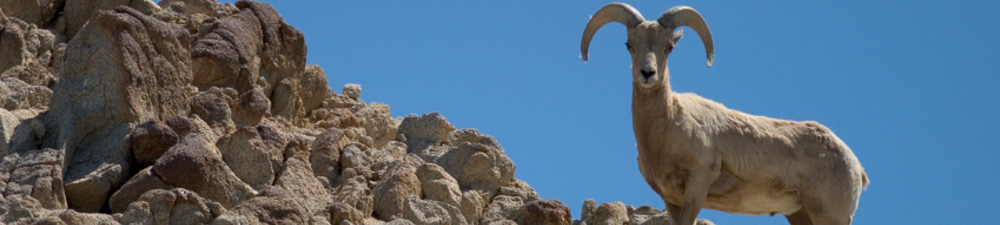
Maintaining a Landscape Linkage for Peninsular Bighorn Sheep
This report presents the current state of knowledge regarding the distribution of bighorn sheep in the Sierra Juarez and recommends future studies needed to further inform strategies for managing bighorn sheep populations and conserving the wilderness corridor between protected parklands in the U.S. and Mexico. (June 2010)
June 2010
Executive Summary
The Peninsular Ranges extend 1,500 km (900 mi) from Southern California to the southern tip of the Baja California peninsula , forming a granitic spine near the western edge of the North American continent. They comprise an intact and rugged wilderness area connecting two countries and some of the richest montane and desert ecosystems in the world that support wide-ranging, iconic species, including mountain lion, California condor, and bighorn sheep. Connectivity at this continental scale is critical to maintaining ecosystem processes, biodiversity, wildlife movement, and habitat values of existing conservation investments in both countries.
This study was undertaken as part of a larger effort to conserve the integrity of this landscape linkage, in the face of increasing sprawl of development inland from the coast, escalating border security infrastructure, and other competing uses for the land. It focuses on the border region of California and Baja California, where the long-term connectivity between federally endangered bighorn sheep in Peninsular Ranges of Southern California and bighorn sheep in Baja California is threatened. The current level of connectivity and the possibilities for maintaining this connectivity in the future are not well understood. This preliminary study assesses the distribution and habitats of bighorn sheep in the Sierra Juárez in Baja California, just south of the international border, the potential threats to bighorn sheep there, and the threats to this landscape linkage, so as to inform conservation and management strategies for linking protected parklands in both countries.

We researched published and unpublished literature, conducted written and oral interviews, used vegetation communities and topography to develop a preliminary model of suitable habitat, and compiled information on reported observations of bighorn sheep in the Sierra Juárez to evaluate the possibility of maintaining or re-establishing long-term connectivity between bighorn sheep populations in California and Baja California, thus allowing genetic exchange and enhancing long-term viability of the species. Our preliminary habitat model indicates that habitat for bighorn sheep is continuous from north of the border south through the Sierra Juárez, and we received observations of bighorn sheep in the Sierra Juárez within this predicted habitat. Given recent sightings of bighorn sheep in the vicinity of Interstate-8 in California, within 8 km (5 mi) of the international border, these findings suggest that long-term connectivity between bighorn sheep populations in the U.S and Baja California is a realistic long-term management goal.
However, the landscape in this border region is rapidly changing as a result of intensified border security infrastructure, increasing urbanization of rural areas, development of renewable energy projects, and incompatible recreational activities, resulting in habitat loss and fragmentation of the landscape. There is a risk that the protected area network that is integral to ecosystem function and wilderness values in both countries could be severed. Furthermore, disease exposure to the endangered bighorn sheep population in California is a serious concern if bighorn sheep in Baja California have elevated exposure to diseases of domestic livestock.
This document presents the current state of knowledge regarding the distribution of bighorn sheep in the Sierra Juárez and recommends future studies needed to further inform strategies for managing bighorn sheep populations and conserving the wilderness corridor between protected parklands in the U.S. and México.


