CBI has been awarded a grant from the California Forest Health Research Program (CAL FIRE) to develop and apply a decision-support system for resilient forest management in the Sierra Nevada with diverse partners.
CBI developed and applied a forest management decision-support system (DSS) for forest resilience planning in the southern Sierra Nevada that integrates the latest science on how vegetation, terrain, climate, and weather interact to influence fire risks and forest resilience. The interdisciplinary team led by CBI includes ecological modelers, forest ecologists, fire scientists, physicists, and statisticians. The core of the DSS will be a Forest Resilience Model built using EEMS (Ecosystem Evaluation Modeling System; Sheehan and Gough 2016). The DSS was tested, refined, and applied to resilience planning in that portion of the modeling region of greatest concern to the interagency Sequoia Regional Partnership, which is working to restore ecologically resilient conditions in and near Sequoia National Forest and Sequoia-Kings Canyon National Park.
This project addressed the need for regionally-relevant forest management decision support tools by developing new models and maps of severe wildfire risk and drought-related tree mortality in the southern Sierra Nevada. The models include multivariate statistical models of drought and fire risks, and transparent modular models using the fuzzy-logic modeling system, EEMS (Ecosystem Evaluation Modeling System (Sheehan and Gough 2016)). The statistical models used the best variables and data available at the time of the project to provide recent snapshots of forest conditions and were used to inform development of the updateable EEMS models to be used in decision-making. The EEMS models of forest resilience rely on variables and datasets that can be updated to reflect environmental change.
This project also developed a method of using statewide forest structure data from the California Forest Observatory (CFO) (California Forest Observatory 2020)) to calculate vegetation-created wind-drag at 10m horizontal and 1m vertical resolution based on how trees, shrubs, and ground cover affect winds below, within, and above forest canopies. These vegetation-based wind-drag coefficients can be used to calculate how oxygen flow to fires is affected by forest structure and thus affects fire behavior. Changes in forest structure, for example due to fires or fuels treatments, may affect fire behavior and the likelihood of extreme wildfire behavior induced by atmosphere-fire coupling (Coen et al. 2020). Because CFO data are California-wide and were expected to be annually updated, wind-drag maps could be updated annually and used to guide fuel-treatment priorities. These results can be immediately applied to improving assessment of the effects and effectiveness of fuels treatments using operational fire models, which to date have not accounted for how reducing fuels also increases ventilation (e.g., FlamMap 6.2). Although the scientific consensus has been that fuels treatments reduce fire intensity within the treatment footprint, it is essential to understand and quantify how they may also increase ventilation into neighboring areas, and hence potentially increase fire risks in unintended ways.
The DSS will be further refined and applied to resilience planning by the Sequoia Regional Partnership, whose primary focus is reducing fire risks to giant sequoia groves, fishers, and human communities.
External Team members include: Joe Werne (NorthWest Research Associates NWRA), Christopher Wikle (Department of Statistics, University of Missouri) and David Marvin (SALO Science).
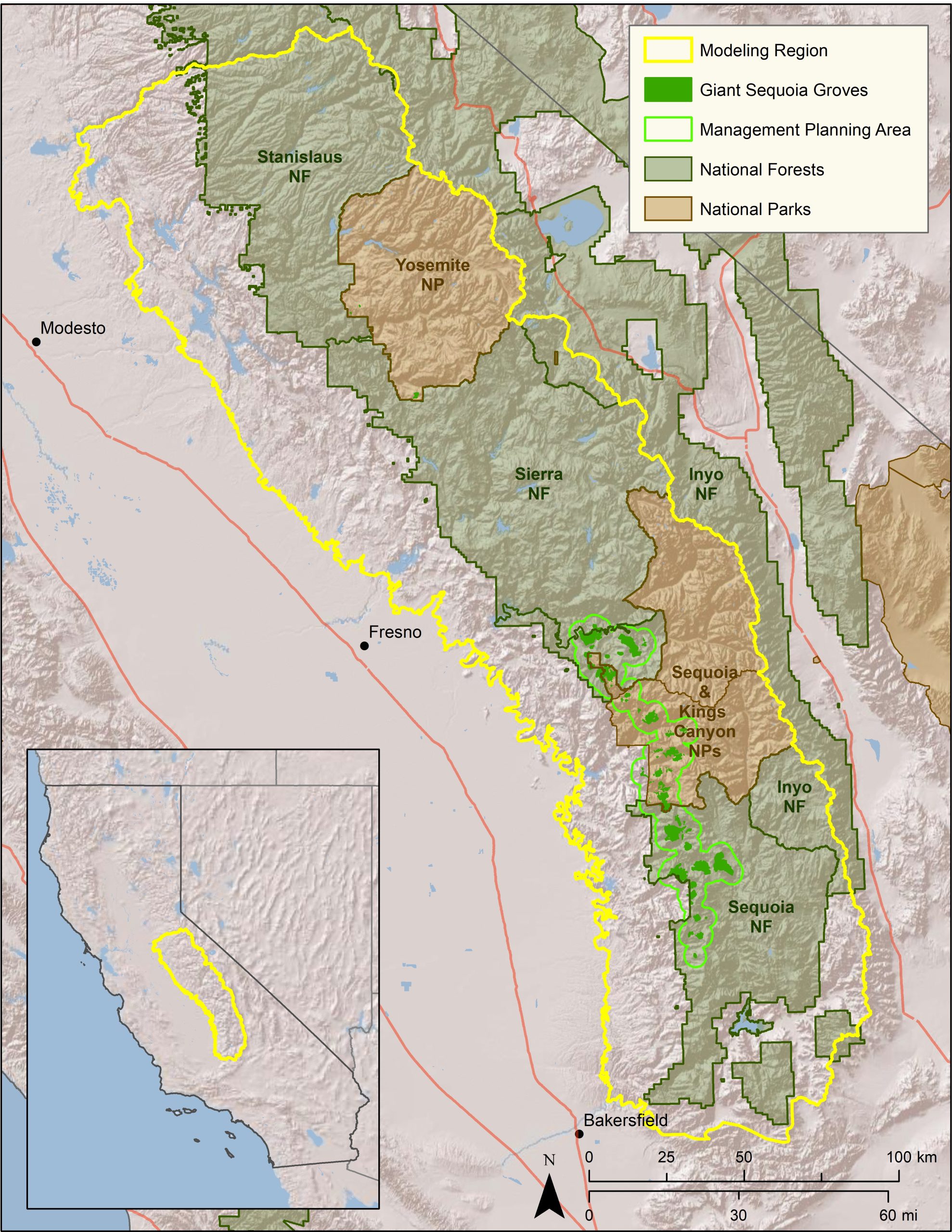 Map of project study area.
Project Details
Location
Date
Services Provided

Conservation Planning & Management

Data Basin

Scientific Research & Modeling

Spatial Analysis & Mapping